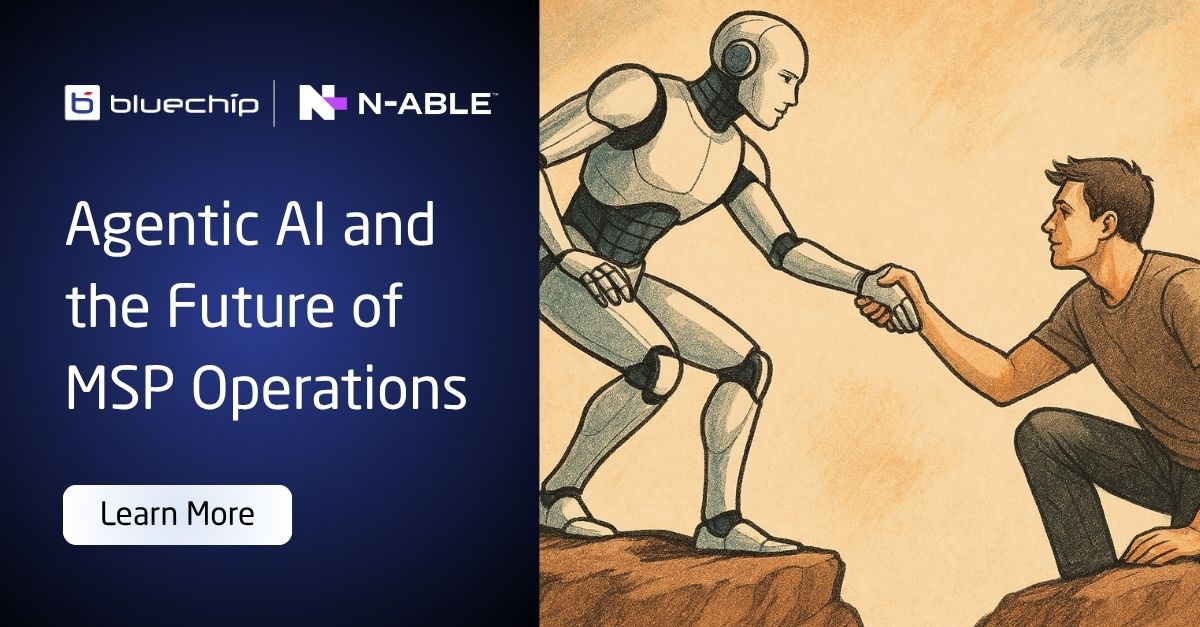
Artificial intelligence has been making its way into IT operations for years, mostly in the form of analytics, dashboards, and recommendation engines. But a new evolution is beginning to take shape, one that goes beyond surface insights and starts to act with purpose. This evolution is known as agentic AI, and it has the potential to fundamentally change how managed service providers operate.
For MSPs juggling growing environments, shrinking margins, and increasing customer expectations, agentic AI is not about replacing technicians. It is about amplifying expertise, reducing friction, and helping teams move from reactive firefighting to deliberate, confident action.
What Is Agentic AI
Most AI tools MSPs encounter today are passive. They analyze information and present results, leaving humans to interpret, decide, and execute.
Agentic AI goes further. An AI agent understands context, evaluates options, and guides the next best action. It operates with awareness of real systems, assets, and conditions rather than generic or disconnected datasets.
In practical terms, agentic AI helps answer questions like:
Why is this endpoint running slowly right now?
Which devices are at risk before users raise tickets?
What should be prioritized today, not just what happened yesterday?
This matters because MSPs are not short on data. They are short on time and clarity.
Why MSPs Are a Natural Fit for Agentic AI
MSP environments are complex by design. Hundreds or thousands of endpoints, diverse client requirements, overlapping tools, and constant alerts create cognitive load that does not scale easily with people alone.
Agentic AI supports MSPs by:
Reducing time to understanding through plain English interaction
Improving prioritization by highlighting what truly matters
Reinforcing consistency by applying best practices across environments
Importantly, this does not remove human judgment. It strengthens it.
Moving From Reactive Tickets to Proactive Operations
Reactive work has long dominated MSP service desks. Tickets arrive with minimal context, technicians investigate manually, and resolution speed depends heavily on individual experience.
Agentic AI changes this pattern by enriching issues before action is taken. When a technician engages with a problem, relevant context is already available, such as:
Affected device and user
Patch and configuration status
Known risks or performance trends
Guided next steps based on best practices
This reduces mean time to resolution and helps prevent recurring problems before they escalate.
The Importance of Embedded, Context Aware AI
Agentic AI delivers the greatest impact when it is embedded directly into day-to-day tools and grounded in live operational data. This ensures that guidance reflects the current state of the environment, not outdated reports.
This is where N Able’s N-Zo fits naturally into the agentic AI conversation. N-Zo is an embedded AI assistant available in both N-Sight and N-Central, delivering context aware guidance directly inside the platforms MSPs already use.
Rather than searching through documentation or switching tools, technicians can ask N-Zo questions in plain English and receive insights based on real endpoint data, configurations, and alerts. The focus is on helping teams decide what matters and what to do next, without disrupting established workflows.
Building Toward Governed Automation
N-Zo focuses on guided insight and decision support, providing a foundation MSPs can trust. Because the guidance is tied directly to operational data within N-Central and N-Sight, it supports informed action rather than guesswork. Over time, this approach creates a steady path from insight to automation, without sacrificing governance or security.
Preparing MSPs for the Next Phase of AI
MSPs preparing for this shift should focus on:
Standardizing tooling and processes
Reducing data silos
Encouraging technicians to work with AI guidance as a partner
Platforms that embed AI directly into operational workflows become natural entry points into this new model of IT operation.
Final Thoughts
The move from passive AI to agentic AI marks an important turning point for MSPs. As environments grow more complex, success depends less on collecting data and more on interpreting it quickly and accurately.
Agentic AI brings intent back into IT operations. By embedding AI guidance directly into MSP platforms and grounding it in real world telemetry, tools like N-Zo help technicians spend less time searching and more time resolving.
For MSPs focused on scale, resilience, and long-term value delivery, agentic AI is no longer a future concept. It is already taking shape.
Learn More About N-Zo
N-Zo is now available in N-Sight and N-Central, providing embedded, context aware AI guidance designed specifically for MSP operations.
To dive deeper into how N-Zo works & what it enables, you can download the feature sheet here.
For additional questions about N-Zo, N-able solutions, or how this technology fits into your MSP strategy, contact us directly at nable@bluechipit.co.nz.