Employees are increasingly accessing AI enabled tools, browser extensions, and local applications outside formal IT channels. This creates a significant visibility gap with unmanaged security, privacy, and compliance risks.
Unapproved AI tools may access or transmit sensitive data and bypass standard IT controls and logging.
AI capable devices (NPUs, GPUs) interact with external 3rd party services that are harder to monitor and control data flow.
AI powered browsers can autonomously navigate, fill forms, and interact with services but these may be exploited to extract data and bypass browser security
Your customers may lack a consolidated inventory of where AI capability exists, and which AI enabled applications are in use, so what can your customers do to mitigate the risk of AI?
One option is to unplug from the Internet, which is about as likely to work as prohibiting AI use so business should adopt one of the AI risk management frameworks, which are very similar to what they should already be doing with other business risks.
Using the NIST AI Risk Management Framework as an example:
Govern: Establish policies and oversight.
Map: Identify context and risks.
Measure: Evaluate impacts and bias.
Manage: Mitigate risk.
Lansweeper asset intelligence can provide AI visibility:
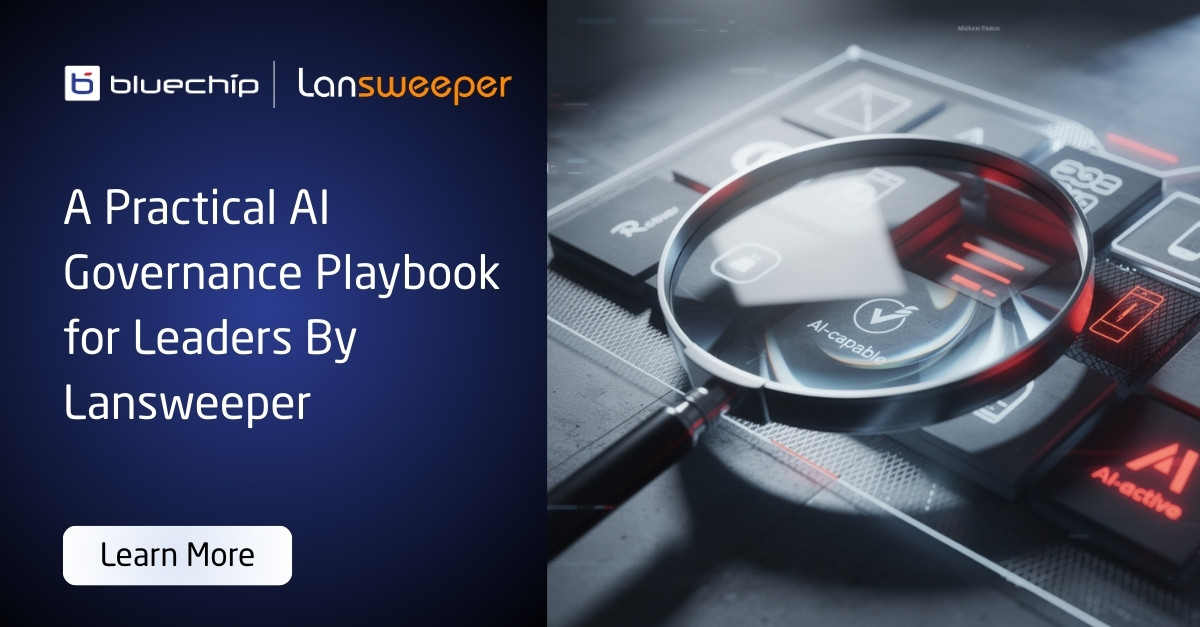
AI Capable Assets Report identifies devices capable of running AI models.
AI Active Assets Report identifies installed AI tools and applications.
For more details there is a Lansweeper article giving practical guidance at A Practical AI Governance Playbook by Lansweeper.
Frequently Asked Questions about AI Governance and Lansweeper
1. Why is unmanaged AI use a risk for my organisation?
Unmanaged AI use introduces security, privacy and compliance risks because employees may adopt AI tools that sit outside formal IT controls. These tools can access or transmit sensitive data, interact with third‑party services, and bypass standard logging, making it harder for security teams to detect and respond to threats.
2. What kinds of AI tools create hidden risk?
Hidden risk often comes from AI‑enabled browser extensions, local AI applications, AI‑powered features inside existing software, and AI‑capable devices such as GPUs and NPUs. These can quietly connect to external services, automate actions like form filling, and move data outside approved channels without IT’s knowledge.
3. Can’t we just block AI tools or turn off Internet access?
Blocking AI tools or disconnecting from the Internet is not realistic for a modern business and usually drives AI use further underground. Instead, organisations should acknowledge that AI is here to stay and manage it as a business risk, using structured AI governance and risk management frameworks.
4. What is an AI risk management framework?
An AI risk management framework is a structured approach to identifying, assessing and controlling the risks created by AI systems. It typically covers governance, policies, risk mapping, measurement of impact and bias, and ongoing risk mitigation, so AI can be used safely and responsibly to support business outcomes.
5. What is the NIST AI Risk Management Framework?
The NIST AI Risk Management Framework (AI RMF) is a widely recognised standard that helps organisations manage AI risk across four core functions: Govern, Map, Measure and Manage. It provides practical guidance on setting policies, understanding where AI is used, assessing impacts and bias, and reducing risk throughout the AI lifecycle.
6. How does the NIST framework apply to everyday AI use in my business?
In practice, the NIST AI RMF helps you:
- Govern by defining clear AI policies, roles and accountability.
- Map by identifying where AI capabilities exist across devices, apps and workflows.
- Measure by evaluating AI outcomes for security, privacy, bias and business impact.
- Manage by implementing controls, training and monitoring to reduce risk over time.
7. Why is AI visibility so important for AI governance?
You cannot govern what you cannot see. Without an accurate inventory of AI‑capable devices and AI‑enabled applications, security and compliance teams are effectively blind. Visibility allows you to prioritise high‑risk tools, enforce appropriate controls, and demonstrate to regulators and customers that AI risk is being taken seriously.
8. How does Lansweeper help with AI visibility and governance?
Lansweeper asset intelligence discovers and inventories AI‑related assets across your environment. The AI Capable Assets Report identifies devices that can run AI models (for example, systems with NPUs or powerful GPUs), while the AI Active Assets Report highlights installed AI tools and applications. This visibility gives leaders the data they need to apply AI governance frameworks effectively.
9. What is the difference between AI‑capable assets and AI‑active assets?
AI‑capable assets are devices with the hardware needed to run AI workloads, such as machines equipped with NPUs or high‑end GPUs.
AI‑active assets are devices where AI tools, applications or browser extensions are actually installed and in use. Understanding both helps you distinguish where AI could run from where it is already running.
10. How can my organisation start building an AI asset inventory?
A practical first step is to use a discovery and asset intelligence platform such as Lansweeper to scan your environment. From there, you can generate reports on AI‑capable and AI‑active assets, tag high‑risk tools, and link this inventory to your AI governance policies, approval processes and user training.
11. Who should own AI governance in the organisation?
AI governance works best as a shared responsibility. Executive leadership sets direction and risk appetite, IT and security teams manage technical controls and monitoring, and risk, legal and compliance functions ensure alignment with regulations. Business leaders then decide how to adopt AI safely within their own teams, within this agreed framework.
12. How often should we review AI tools and devices in use?
AI usage and tools change quickly, so reviews should not be a one‑off exercise. Many organisations perform continuous discovery alongside a formal review at least quarterly. Regular reporting on AI‑capable and AI‑active assets helps you keep pace with new tools, update policies, and retire or restrict high‑risk applications.